
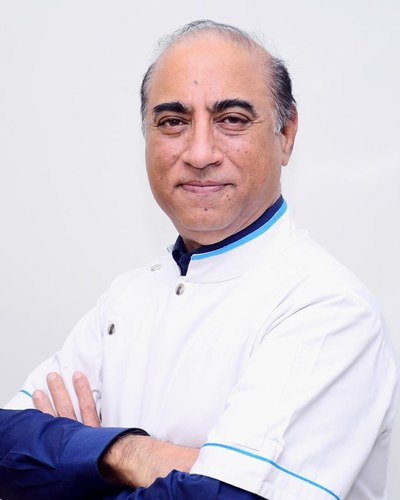
Rohit Kochhar
MDS
I. T. S. Dental College Hospital and Research Centre, Greater Noida, Uttar Pradesh, India
INDIA
Session 38 · DAY 3 (Nov. 7, 2026) · 16:30–17:00 CET
Intentional Reimplantation-The Road Less Taken
Abstract
Post-treatment endodontic disease, defined as the persistence or development of an inflammatory periapical or periradicular lesion in a previously root-filled tooth, is a significant issue for oral health care providers, especially for endodontic specialists.
The primary cause has been attributed to the presence of microorganisms in the root canal system and/or the periapical tissue. Several treatment options with varying levels of success have been suggested, including nonsurgical endodontic retreatment and apical surgery. Because of improved operational efficiency, difficulty with surgical access, and the desire to avoid delicate anatomic structures, intentional replantation has been proposed as an additional method to resolve post-treatment endodontic disease in select cases.
Intentional replantation has been defined as the deliberate extraction of a tooth and after evaluation of root surfaces, endodontic manipulation, and repair, placement of the tooth back into its original socket.
Cases like zipping, transportation, root perforation, ledges in the inaccessible areas of the root and other non-negotiable situations, intentional reimplantation treatment option can be very promising to give relief to the symptomatic patient where the patient is willing to go for extraction as the last resort. The procedure includes atraumatic extraction, retrograde cavity preparation (2-3mm depth), and retrograde filling to promote healing. Further, the root can be biostimulated using laser, before reinsertion of the tooth, for better prognosis.
A wide range of success rates has been reported, and yet this treatment method has often been regarded as a treatment of last resort.
Recent studies have shown more consistent success rates as high as 88% to 95%. In light of the new studies, intentional replantation may now be considered a more commonly accepted treatment modality.
Learning Objectives
- Indications and contraindications
- Pre-Treatment planning
- Steps of the procedure
Biography
Dr Rohit Kochhar, MDS, is an alumni of prestigious Saveetha dental college, chennai. He completed his MDS in the year 1999 and has a total teaching experience of over 23 years
Currently, he is working as Professor and Head In the deptt of conservative dentistry and Endodontics at ITS dental college, greater Noida, India, mentoring 18 post graduate students
He has been the Executive committee member and Vice president of the IACDE (Indian Association of Conservative dentistry &Endodontics) and IES (Indian Endodontic Society)
He is the recipient of Best teacher award by the CCS university, Lucknow, India in the year 2018
Received the ICMR (Indian Council of Medical Research) PG grant in 2025.
He has over 60 publications in pubmed and Scopus journals and he has co-authored 5 textbooks
His area of interest is Intentional Reimplantation. He and his team have successfully done over 200 cases of Intentional Reimplantation at their Research centre, with 95 percent success rate.
He is the member of Institutional ethical committee at his institute as the clinical expert
He has successfully running practice in New Delhi, India, for the last 22 years
Has chaired various sessions at the national and international podiums
An avid teacher and found his niche in the areas of endodontics and Intentional reimplantation